What Should I Do With My Golf Cart When I Move Out of The Villages?
Key Takeaways
- Your cart is not part of your home sale. It is a personal asset, not tied to the deed, so you can sell it, keep it, trade it in, or donate it
- Standard golf carts are not titled or registered with the state of Florida. They sell with a bill of sale and the serial number
- Low-speed vehicles (LSVs) are different. A cart that reaches 20 to 25 mph is titled and registered like a car and needs a proper transfer
- Private resale usually nets more; dealer trade-ins are faster. The Villages resale market for carts is active, with used carts typically selling between $3,000 and $10,000
- If you take the cart, check your new state's rules. Carts are street-legal only where local roads are designated for them, never on sidewalks
When you sell your home in The Villages and move away, your golf cart is a personal asset, not part of the sale, and you have three good options: sell it before you go, take it with you, or trade it in with a local dealer. The cart is not tied to your deed, so nothing about your closing obligates you to keep it or hand it over. I am Lili Whittington, Broker Associate with Soundings LLC (Florida license BK3090328, CLHMS, SRES, MRP, ABR, SFR, CIPS), your bilingual Villages realtor, and after more than 20 years and over 450 homes sold in The Villages and the surrounding Marion, Sumter, and Lake counties, the golf cart question comes up in nearly every move-out conversation, right after the amenities fee.
It makes sense that it does. The Villages is known as the Golf Cart Capital of the World, with more than 85,000 golf carts and over 100 miles of dedicated multi-modal paths, and for most residents the cart is how they run errands, meet friends, and get to the town squares. When you leave, that trusty cart sitting in the garage is a real decision with real money attached. In this guide I will walk you through what you own, your three options, the paperwork, and the timing, so the cart never complicates your home sale. If you would rather just talk it through, my phone and calendar are at the bottom of this page.
Your Golf Cart Is Yours, Not the House's
The first thing to understand is the simplest one: your golf cart is personal property, like your furniture or your car, and it has nothing to do with the deed to your home. When a buyer purchases your Villages house, they are buying the real estate, the structure, and the land. Your cart stays yours unless you decide otherwise.
That said, sellers do occasionally leave a cart behind on purpose. A cart can be a sweetener in a negotiation, especially for a buyer relocating from out of state who wants to start cart life on day one. But that is a choice you make, not a requirement, and it should be written into the contract if you go that route. Most sellers I work with sell the cart separately, because a good used cart in The Villages moves quickly and the money is theirs to keep.
Know What You Own: Standard Golf Cart or Low-Speed Vehicle
Before you do anything, figure out which of the two legal categories your cart falls into, because they are handled very differently. Under Florida law, a standard golf cart is a vehicle designed for golf-course use that cannot exceed 20 miles per hour, and it is not required to be titled, registered, or insured by the state of Florida. The state simply does not keep a title for it. Most carts in The Villages fall into this category, which is why you will hear people say they are "untitled."
A low-speed vehicle, or LSV, is the exception. An LSV has a top speed greater than 20 miles per hour but not more than 25, and Florida treats it much more like a car: it must be titled, registered, and insured, with personal injury protection and property damage liability coverage. If your cart was built or upgraded to LSV specifications, it carries a vehicle identification number and a Florida title, and selling or moving it means a real DMV transaction. Not sure which you have? Check the serial number plate on the frame, or ask the dealer who sold it to you. The Florida Department of Highway Safety and Motor Vehicles publishes a helpful low-speed vehicle guide, and the law itself is Florida Statute 316.212.
Option 1: Sell It Before You Move
For most sellers, selling the cart before the move is the cleanest path, and The Villages has one of the most active used-cart markets in the country. New carts typically run $7,000 to $15,000, while good used carts commonly sell for $3,000 to $10,000 depending on age, condition, batteries, and upgrades. Custom paint, seating upgrades, and accessories hold real value here, so a well-kept cart is a genuine asset.
You have two sales routes. Private resale usually nets the higher price, and residents do it through Facebook Marketplace, the Talk of The Villages forum, and specialized sites like Villages Golf Cart Trader. Because the community is full of new arrivals and seasonal residents looking for a cart, a fairly priced used cart often sells within days. Dealer trade-in or buyback is the faster route: dealerships that serve The Villages, such as Masters Golf Cars and Village Discount Golf Cars, buy carts outright and handle most of the paperwork for you. You will typically net less than a private sale, but you trade that for speed and convenience, which matters when you are packing a whole life into a moving truck.
Option 2: Take It With You
If you are moving to another golf-cart community, a retirement development, or a state where carts are welcome on designated roads, taking the cart makes sense. But check the rules at your destination before you commit to the trailer. Florida law allows golf carts on roadways that local governments have specifically designated for cart use, generally with posted speed limits of 30 miles per hour or less, and many other states are far more restrictive, limiting carts to private property, gated communities, or specific routes. Golf carts are never allowed on sidewalks, and a cart that is street-legal in The Villages may not be street-legal in your new town.
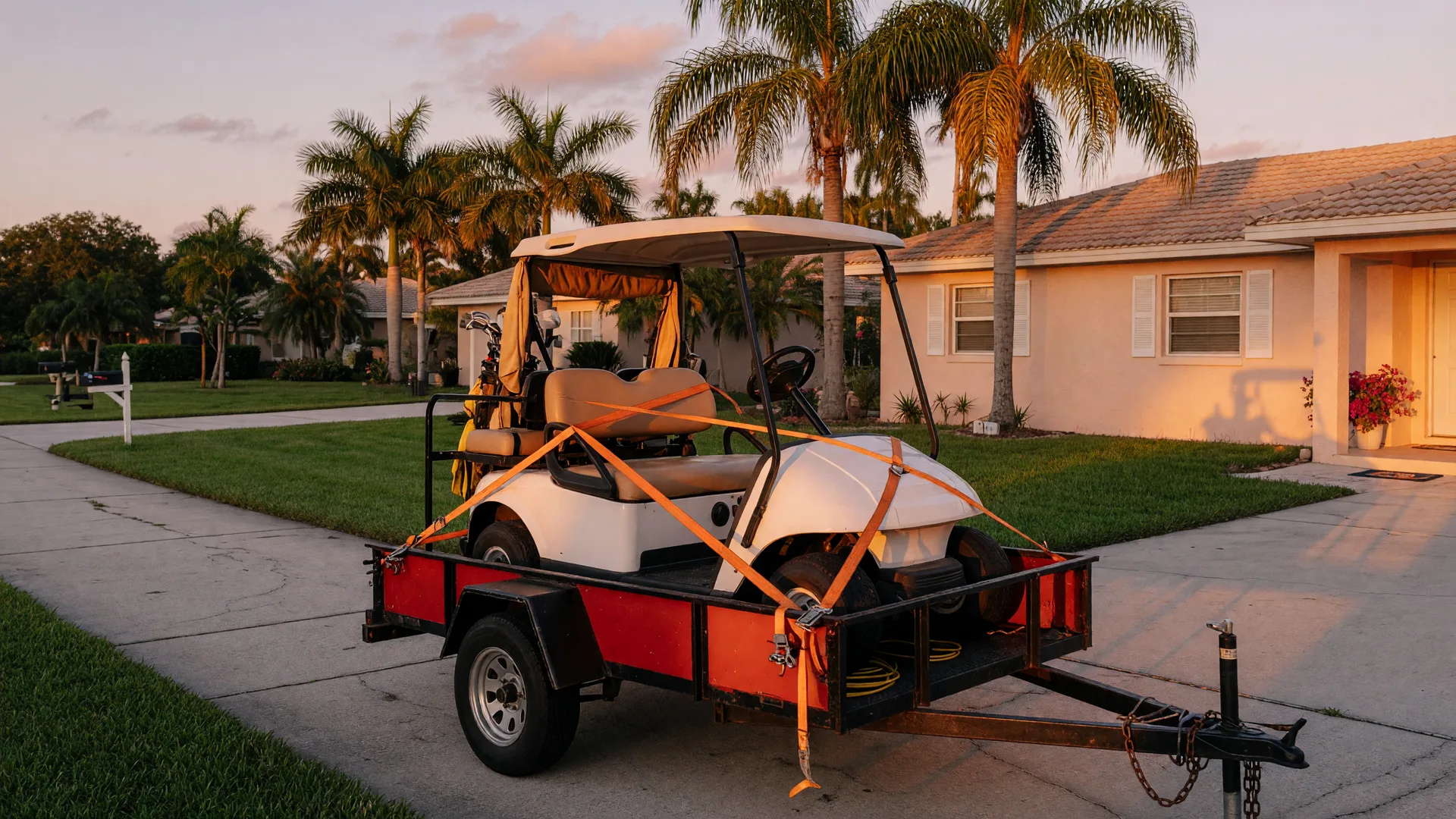
There is also the practical side. Transporting a cart means a trailer or a hauling service, and if your cart has lead-acid batteries, they need care during a long trip. Ask yourself honestly how much you will use it at the new address: a cart that is perfect for Florida's flat, warm, cart-path world can be a garage ornament in a cold-weather state for half the year. If your new home is a snowbird property you will visit seasonally, some owners keep the cart at the Florida rental or with family instead of hauling it back and forth.
Option 3: Trade It In or Donate
Trading in is the option that combines a sale with your next chapter. If you are buying a new cart at your destination, or even a different model altogether, a local Villages dealer may give you trade-in credit that reduces what you pay next. It is the least paperwork of all the routes, because the dealer takes ownership and handles the transfer, and it is especially popular with sellers who are moving to another active-adult community.
Donation is a quieter option that works for older carts with tired batteries that would be hard to sell. Several charities accept golf carts, and if you go this route, get a written receipt and ask your tax preparer whether a deduction applies in your situation. I am not a tax professional, and the rules change, so let the expert confirm it before you count on it.
Timing It Around Your Home Sale
The cart decision and the home sale are separate, but they should be planned together. A cart parked in the garage makes the space look smaller in listing photos, so most sellers I work with clear the garage before the photographer arrives, whether that means selling the cart, moving it to storage, or parking it at a friend's place during showings. If you are selling from out of state, settle the cart's fate before you list, because coordinating a cart sale from a distance adds a layer you do not need.
There is one more money question worth flagging: the amenities fee runs with the property, not the person. When you sell, the buyer assumes the monthly amenities fee, about $204 a month for new buyers in 2026, which is what funds the recreation centers, pools, golf, and town squares your cart used to roll you to. Your cart sale has nothing to do with that fee, but knowing how it transfers helps you price your home and your timeline realistically. I cover that in detail in my guides on what happens to the amenities fee when you move out and preparing your home before you move.
The Paperwork, Simplified
Here is the whole paperwork story in one paragraph. For a standard golf cart: write a bill of sale with the buyer's name, the price, the date, and the cart's serial number, hand over the keys and charger, and you are done. There is no title, no DMV visit, and no registration to cancel, because the state never issued one. For an LSV: complete the title transfer through the Florida DMV like any vehicle, sign the title over to the buyer or dealer, and cancel or transfer your insurance policy when you move. And whatever you drive, if you carry a standalone golf cart insurance policy, call your agent when the cart is gone so you are not paying for coverage on a cart you no longer own.
One habit I recommend to every seller: keep a photo of the serial number and a copy of the bill of sale in your records. It takes thirty seconds, and it protects both you and the buyer if any question ever comes up about the cart's history.
The Bottom Line on Your Cart
Your golf cart is one of the most personal parts of life in The Villages, and leaving it behind can feel bigger than the dollars involved. The good news is that you have real choices, a strong resale market, and dealers who will make it easy. Decide early, know whether you own a standard cart or an LSV, and keep the paperwork simple, and the cart becomes one less thing to worry about while you plan your next chapter.
If you are moving out of The Villages, whether you are selling from here or from across the country, I can help you time the home sale, the cart, and the paperwork so nothing slips. I have guided more than 450 homes sold over 20-plus years in The Villages and Marion, Sumter, and Lake counties, and I do it in English and Spanish. Call or text me at 954-235-4766, or book a time on my calendar, and let us map out your move together.
FAQ About Your Golf Cart When You Move Out of The Villages
Is my golf cart included in the sale of my home in The Villages?
No. Your golf cart is a personal asset, not part of the real estate, and it is not tied to your deed. You can sell it separately, take it with you, trade it in, or donate it. Leaving a cart behind as a negotiating sweetener is a choice some sellers make, but it is never a requirement of the sale.
Do I need to transfer golf cart registration when I move out of The Villages?
For a standard golf cart, no. Standard carts are not titled or registered with the state of Florida, so there is nothing to transfer. You sell with a bill of sale and the serial number. A low-speed vehicle (LSV) that reaches 20 to 25 mph is titled and registered like a car, so that one must be transferred through the Florida DMV and its insurance handled like any other vehicle.
Can I drive my golf cart in another state after I move?
Only where the local government has designated roads for golf cart use. Florida allows carts on designated roadways with posted speed limits of 30 mph or less, and many other states restrict carts to private property, gated communities, or specific routes. Check your new city and county rules before you plan to drive it, and remember golf carts are never allowed on sidewalks.
Should I sell my golf cart before or after I list my home?
Most sellers decide before listing so the garage photographs clean and the home shows at its best. A cart in the garage can make the space look smaller in photos. If you are selling from out of state, settle the cart's fate early and have the bill of sale and serial number ready for the buyer.
Whether you are moving next month or next year, the cart question is easy to solve once you know the rules. I am Lili Whittington, Broker Associate with Soundings LLC (Florida license BK3090328), your bilingual Villages realtor, and I help sellers in English and Spanish across The Villages and Marion, Sumter, and Lake counties. Call or text me at 954-235-4766, or book a time on my calendar, and we will plan your move together.
Related Posts
Golf Cart Culture in The Villages, FL: The Golf Cart Capital of the World
85,000+ carts, 100+ miles of paths, rules, and daily life on the cart.
Seller's GuideWhat Should I Do With My Home Before Moving Out of The Villages?
Sell or rent, declutter, repairs, staging, the amenities fee, and the paperwork.
Seller's GuideHow Do I Sell My Home in The Villages From Out of State?
Remote Online Notarization, mail-away closings, and a local listing team.
Seller's GuideCan I Sell My Home in The Villages and Move Back North?
Capital gains, the homestead exemption, timing, and the selling process.

About the Author
Lili Whittington, MBA is a Broker Associate with Soundings LLC in The Villages, FL, licensed as a Florida broker associate (BK3090328). With over 20 years of experience and 450+ homes sold throughout The Villages and Marion, Sumter, and Lake counties, Lili holds the CLHMS, SRES, MRP, ABR, SFR, and CIPS designations and specializes in retirement relocation, luxury homes, and seller representation for local, national, and international clients, fluent in English and Spanish. She helps every seller plan the move-out details, from the golf cart to the amenities fee, so the sale closes cleanly.
Planning your move out of The Villages?
Get a clear, straight answer about selling your home, what to do with your golf cart, and how the amenities fee transfers, from someone who has guided more than 450 homes sold over 20-plus years. Ask Lili anything about the selling process, in English or Spanish.
Call or text Lili at: 954-235-4766 · Email: Liliana.whittington@soundingsrealestate.com
Book a Consultation With Lili